Google Website Translator Gadget

Showing posts with label IMF. Show all posts

Dec 21, 2012

2013 Greek Budget: More Austerity

The Greek Government will again implement significant budget cuts in 2013, which it agreed on in November with the Troika. Pensions and state salaries are the main places where the cuts will take place. The reduction in the deficit consists for about 4/5th of budget cuts and 1/5 of tax increases. This total planned tax increases and budget cuts in 2013 are 9.4 billion euro's.

The reduced budget deficit will still increase the government debt however.

Note: the Greek parliament has approved the budget in November.


Dec 18, 2012

Greek Debt Composition 2012

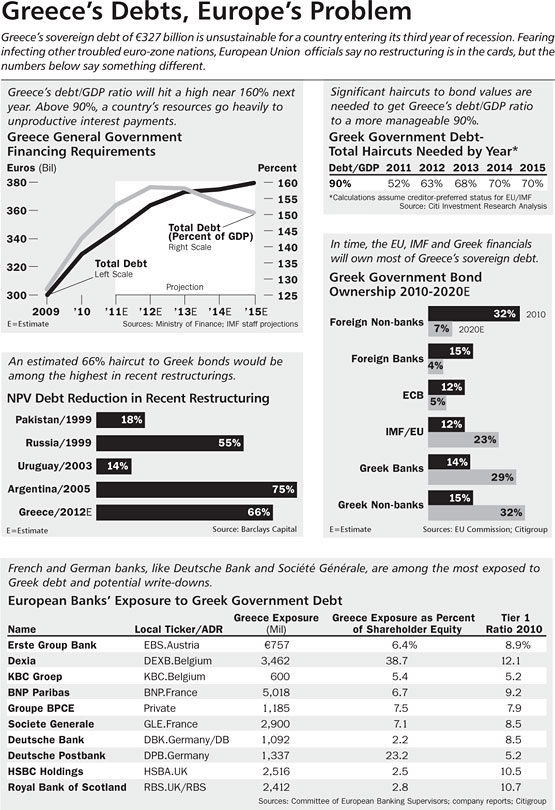
One reason the Northern European countries bailout out Greece was because banks, for example German en French banks, heavily invested in Greek government debt. Since then the European Commission (EFSF) and the ECB have bought quite a lot of debt from the banks. This means that the bond holders of Greek debt shifted from only private parties to mostly public holders now.

This means that when there would be a second round of writedowns on Greek debt the European tax payer will have to pay as well.


Nov 2, 2012

IMF Euro Zone GDP Forecasts (WEO Fall 2012)

This graph shows the latest IMF forecasts for the GDP growth rates for a number of selected countries. For most countries the next few years won't be easy, but will see GDP growth rates get out of negative territory gradually. Greece is even expected to grow by more than three percent from 2016.


Bondvigilants

Oct 8, 2012

Unprecedented Global Housing Boom

The IMF constructed this graph with housing price data from 55 countries. From 2002 and on there was a huge rise in global housing prices. The decline afterwards was also not seen in at least the last 40 years. Lately the housing prices seem to bounce back a bit, but this could be temporary as well since the house prices are still on a very high level.

IMF

Nov 9, 2011

Greek Rescue Deal & EFSF Enlargement Graphed

Key Points:

  1. Private sector writes off 50% of Greek Government debt.
  2. EFSF bailout fund scaled up to 1 trillion.
  3. European Banks to be recapitalized with 100 billion euros.
  4. Second bailout-package for Greece is 130 billion euros with EFSF-money, instead of 109 billion agreed in July 2011.


Oct 4, 2011

IMF World Growth Projections (WEO September)

This graph from Reuters shows the latest projections for economic growth in 2011 and 2012 in different continents. Almost all of the projections have been lowered since the forecast of June.

Reuters

Aug 31, 2011

Eurozone Future According To J.P. Morgan


ZeroHedge published this graph from J.P. Morgan which visualizes one scenario of the future of the Eurozone in a war map.
  1. ECB purchases bonds in secondary market.
  2. EFSF expanded to 440bn Euros - expected to happen this fall.
  3. EFSF will lend to Spain and italy.
  4. Increase EFSF to 1.0-1.5 trillion.
  5. EU asks IMF to increase its share in the EFSF fund.
  6. Allow EFSF to the rated AA, to increase its lending capacity.
  7. Same as 4.
  8. Eurobonds.

ZeroHedge


Aug 22, 2011

Current (EFSF) and Future (ESM) Euro Bailout Mechanims

This graph from Der Spiegel shows what the current Euro bailout fund is made of (called the EFSF) and on the right you can see the funding of the bailout fund from 2013; the Capital and Guarantees per country in billion euro's.

Der Spiegel

Jul 29, 2011

How Will Greece Use The Second Public Bailout Money?

On the 21 of July Euro Zone leaders announced that Greece will get a second public bailout from the Euro Zone Countries (Lend by the EFSF bailout fund) and the IMF. The second bailout amounts 109 billion. This graph shows how the second public bailout out money will be used by Greece:


  • 34 billion to refinance its debt.
  • 20 billion to recapitalize Greek banks.
  • 20 billion to buy back Geek Bonds, which will result in a 12,6 billion decline in the Greek Debt.
  • 35 billion for collateral (AAA-loans from EFSF) for extending the bonds by the private sector (private sector bail out). 
  • The assumption is that Greece will raise 28 billion by privatization. If it will not the 109 billion public bailout will have to rise.


Jul 18, 2011

History of Global Debt

The IMF made an interesting video about the history of public debt from 1980 until recently in developed, emerging and low-income countries.

Jun 22, 2011

Holders of Greece, Ireland and Portugal Debt

'Who holds the sovereign debt of Greece, Ireland and Portugal? Not an easy question. So, RBC Capital Markets compiled figures and MarketBeat/WSJ published them. Bellow, are the charts  of the estimated debt exposure.'


LisWires

Jun 11, 2011

Bailouts of Greece, Ireland and Portugal in Perspective

This infograph from Der Spiegel compares the three bailouts and their creditors.

Update: notice only the first bailout for greece has been pictured. The second bailout is 130 billion euro's.

Source: Der Spiegel

May 26, 2011

Which Countries Owe Money To The IMF?

The Guardian made a layer in Google Maps with all the countries that currently receive a loan from the IMF, with all the information about the loans as well.

Check this link for the interactive version:


May 13, 2011

Who's paying for the euro-area bail-out?

This great graph from The Economist show who pays for the Euro(pean) bail out funds.


Due to a request by the Economist this graph has been removed. 

Apr 16, 2011

DUTCH: American (and other countries) Debt Problems

This picture gives the budget deficit for 2011 in selected countries, with the U.S. on top.
Source: Z24


Budget deficit in 2016 for these countries:
Source: Z24
This picture gives a great overview of the situation of the public finances for selected countires
These are the fiscal consolidations needed to before 2030 as computed by the IMF

Apr 13, 2011

The Economist:

IMF warns of high spending in Japan and United States, says Europe is on the right track for fiscal consolidation. 


The Economist made a graph with budget defitcit as a percentage of GDP and Gross Government Debt with projection from the IMF WEO Spring 2011. The Economist: 'On April 13th President Barack Obama is set to present yet another plan to reduce the country's mammoth deficit. America's economy is so large, and foreign appetite for greenbacks so voracious, that it seems inconceivable that it could suffer a fate similar to that of Portugal or Greece. The IMF's World Economic Outlook (WEO), published today, aims to shatter such complacency. America, its authors write, lacks a credible strategy for dealing with its growing public debt, and is expanding its budget deficit at a time when it should be shrinking. The chart below, drawn from the WEO, illustrates the size of the problem America faces.'


Source: The Economist

IMF WEO Spring 2011: Non-financial Corporations Debt

Non-financial Corporations Debt is the highest in Greece and the lowest in the United States as a percentage of Financial Assets.
Source: IMF